Automate Orders with a Magento Dropshipping Supplier API
Scaling a Magento store requires more than just a functional storefront; it demands a backend capable of sophisticated logic and reliable data transmission. For retailers relying on external vendors, a robust dropshipping api integration is the critical link between a customer placing an order and the supplier shipping it.
However, complex supply chains often require more functionality than a standard magento 2 dropshipping extension can provide on its own. Dropday acts as the advanced operational layer between your Magento environment and your suppliers. Instead of managing isolated connections, you can configure flexible rules to automate the transfer of order data through one centralized platform.
The Challenge with Native Magento Dropshipping
Adobe Commerce (Magento) is a powerful platform for managing catalogs and front-end experiences. However, its native capabilities for order routing often hit a ceiling when dealing with diverse supplier requirements. A standard setup might handle basic email notifications, but it struggles to communicate with modern supplier systems that require structured data payloads.
Usually, this forces webshop owners to develop custom API connectors for every single supplier. This approach leads to a bloated codebase, high maintenance costs, and potential conflicts during platform updates. By decoupling the integration logic from the core platform, Dropday allows you to connect with unlimited suppliers without altering your shop's codebase.
How the API Connection Works
The core function of Dropday in this context is to act as a translator and traffic controller. The workflow operates as follows:
Order Import: Dropday pulls new orders from Magento in near real-time.
Logic Application: The system applies your pre-configured rules (e.g., if SKU starts with "X", route to Supplier A; if destination is UK, route to Supplier B).
Data Transformation: Dropday converts the Magento order data into the specific JSON format required by the supplier's API.
API Execution: The order is transmitted securely via a POST, PUT, or GET request.
This process ensures that the supplier receives clean, validated data instantly, reducing the fulfillment time significantly compared to manual processing or batch file exports.
The Mechanics of API Configuration
Technical flexibility is essential when building a sustainable dropshipping api integration. Suppliers rarely use a standardized API structure; one might require a complex nested JSON object with specific headers for authentication, while another might need a flat structure sent to a different endpoint.
Hardcoding these variations directly into Magento is inefficient. Dropday solves this by providing a configurable interface where you can build the API call visually. You define the endpoint, the method, and the body content using dynamic variables. This means you can adapt to changes in a supplier’s API documentation immediately without needing a developer to rewrite your store’s integration module.
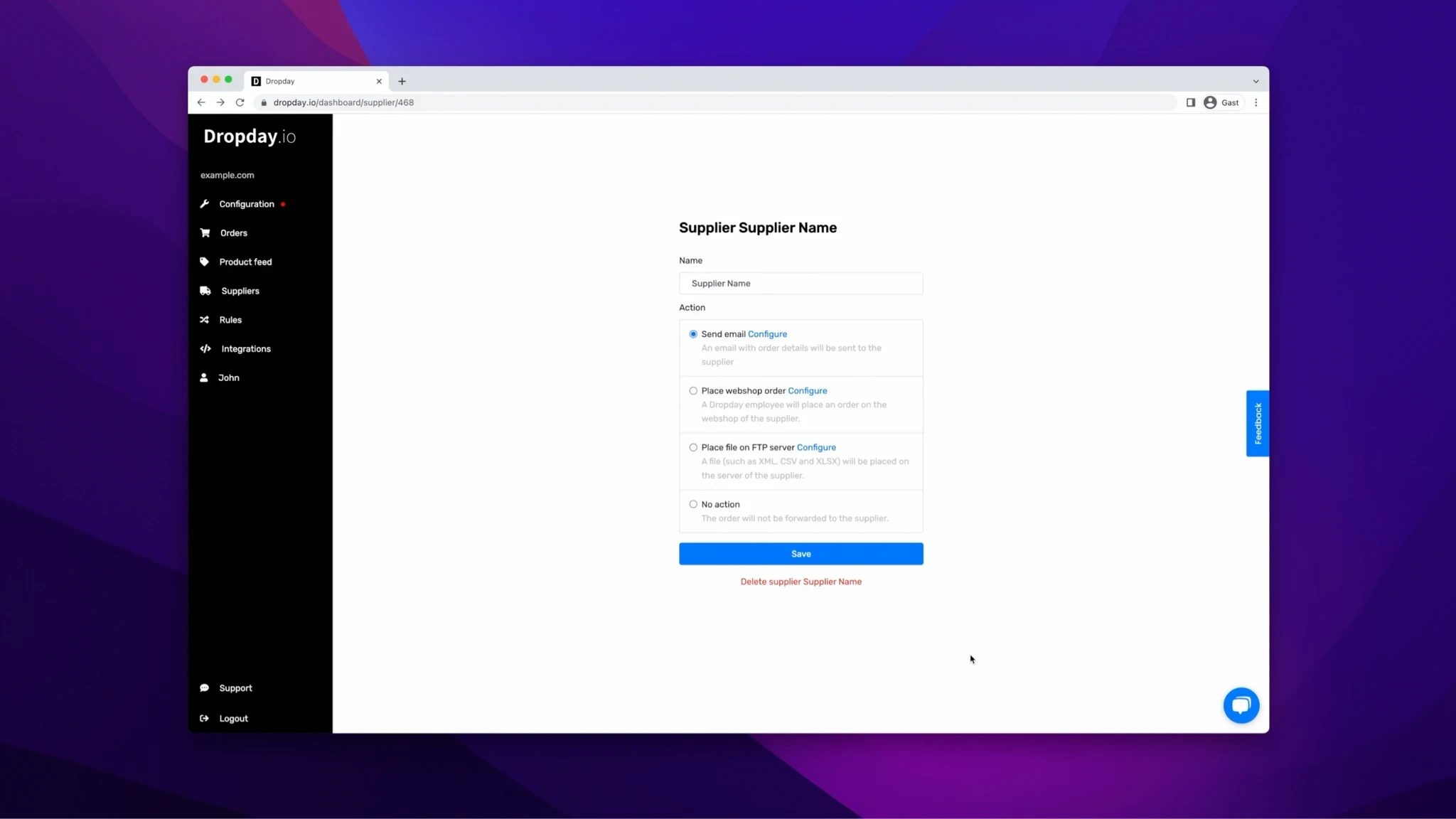
Configuring Custom JSON Payloads
Dropday allows you to place dropship orders via API call by letting you construct the exact payload your supplier expects. You are not limited to a pre-set template.
Key capabilities include:
Fully Configurable Formats: Support for POST, PUT, and GET methods.
Dynamic Variables: Insert order-specific data directly into the JSON body using variables. For example, you can map your Magento
increment_idto the supplier'sreference_field.Custom Headers: Define specific content types or authentication tokens required by the vendor.
Real-time Transmission: Orders are sent the moment they pass your validation rules.
Here is a conceptual example of how a JSON body might be configured using variables:
By mapping the internal variables to the JSON structure, you ensure that the data arriving at the supplier is always accurate and formatted correctly for their ERP or WMS.
Operational Control and Error Handling
Blind automation is a risk in e-commerce operations. Relying on automation without oversight means errors often go unnoticed until a customer complains about a missing shipment.
Dropday emphasizes process control. If an API call fails (for example, due to a server timeout at the supplier or invalid address data), the system flags the order for manual review. You can see exactly what data was sent and what error code the supplier returned. This transparency allows your operations team to resolve issues quickly. It adds a necessary layer of verification to your magento dropshipping workflow, ensuring no order ever falls through the cracks.
Handling Legacy Suppliers (EDI and FTP)
While API integration is the gold standard for modern e-commerce, not all suppliers are technically advanced. You may work with vendors who still rely on older standards like EDI or CSV files via FTP.
A robust operations platform must handle hybrid environments. You can configure Dropday to send JSON API requests to your modern tech partners while simultaneously generating and sending EDI files to legacy suppliers, all derived from the same stream of Magento orders. This allows you to modernize your side of the operations without being held back by the technical limitations of your supply chain partners.
Summary
Implementing a magento dropshipping supplier api workflow does not require heavy custom development. By using Dropday as a middleware layer, you gain the ability to connect with any supplier system, maintain full control over your data, and scale your operations without adding administrative headcount.