Automating Drop Shipments with a Magento EDI Integration
Adobe Commerce (Magento) is widely recognized for its robust catalog management and flexibility on the frontend. However, for e-commerce managers overseeing complex supply chains, the backend reality often involves a disconnect between the webshop and the supplier. While your store processes orders digitally, many established distributors and manufacturers still require orders to be submitted via Electronic Data Interchange (EDI).
Creating a functional magento edi workflow is often the difference between manual data entry and a fully scalable operation.
Without an automated layer, teams are forced to manually transcribe order details from Magento into supplier portals or standardized text files. This introduces latency and human error. By implementing a dedicated magento dropshipping integration that supports EDI standards, businesses can ensure that order data flows directly from the checkout to the supplier’s ERP without manual intervention. Furthermore, adopting reliable dropship edi protocols ensures that you can meet the strict technical requirements of major distributors without changing your internal platform.
The Operational Gap in Magento Dropshipping
Magento is architected primarily as a B2C and B2B sales platform, not as a supply chain automation tool. Out of the box, it excels at capturing the transaction but lacks the native tools to format that data into the rigid structures required by legacy distributors.
When a magento dropshipping extension or native workflow is used, the default output is typically a transactional email or, at best, a standard CSV export. For suppliers operating on thin margins and high volumes, these unstructured formats are inefficient. They often require the webshop to adhere to strict EDI protocols (such as EDIFACT or ANSI X12) to ensure their warehouse systems can ingest the order automatically.
Attempting to build this functionality directly inside Magento often leads to bloated codebases and maintenance issues during platform updates. A more stable approach involves using an external automation layer to handle the translation and transmission of data.
Why Dropship EDI Standards Matter
The requirement for EDI usually comes from the supplier side. Large vendors prioritize partners who can submit orders electronically because it eliminates data entry on their end. To automate this, your system must speak their language.
Implementing dropship edi standards ensures that order data is standardized regardless of the source. Whether the supplier requires an EDIFACT D96A message or an ANSI X12 850 purchase order, the strict validation of these formats prevents common errors like missing SKUs, incorrect address formatting, or undefined shipping codes.
The challenge lies in mapping the dynamic, flexible data fields from Magento to these static, rigid EDI definitions.
How a Magento EDI Workflow Operates
A successful magento edi integration functions as a translator and courier. It does not alter the Magento core; instead, it extracts data, transforms it, and delivers it.
The workflow follows a logical sequence:
Data Extraction: The automation platform retrieves the new order from Magento via API. This ensures real-time processing rather than waiting for scheduled batch exports.
Supplier Routing: Logic rules determine which supplier should fulfill the order based on SKU, stock availability, or destination.
EDI Translation: The system maps the Magento order data (Billing, Shipping, SKUs, Quantities) into the specific EDI format required by that supplier.
Transmission: The generated file is uploaded to the supplier’s server, typically via FTP, SFTP, or AS2.
This process happens in the background, allowing the operations team to focus on exceptions rather than routine order placement.
Configuring EDIFACT and X12 for Magento
Different suppliers use different standards depending on their location and industry. A robust magento edi solution must handle multiple formats simultaneously.
EDIFACT (International)
Common in Europe and Asia, EDIFACT is a widely used standard. A typical dropship order is sent as an ORDERS message. The automation layer must correctly segment the data, ensuring that the interchange header (UNB), message header (UNH), and line item segments (LIN) strictly follow the syntax version the supplier expects.
ANSI X12 (North America)
Suppliers in North America typically utilize the ANSI X12 standard. The standard purchase order document is the 850. In this context, the automation software must translate Magento's shipment method codes into the specific carrier codes defined in the X12 specification (e.g., translating "FedEx Ground" to code "U").
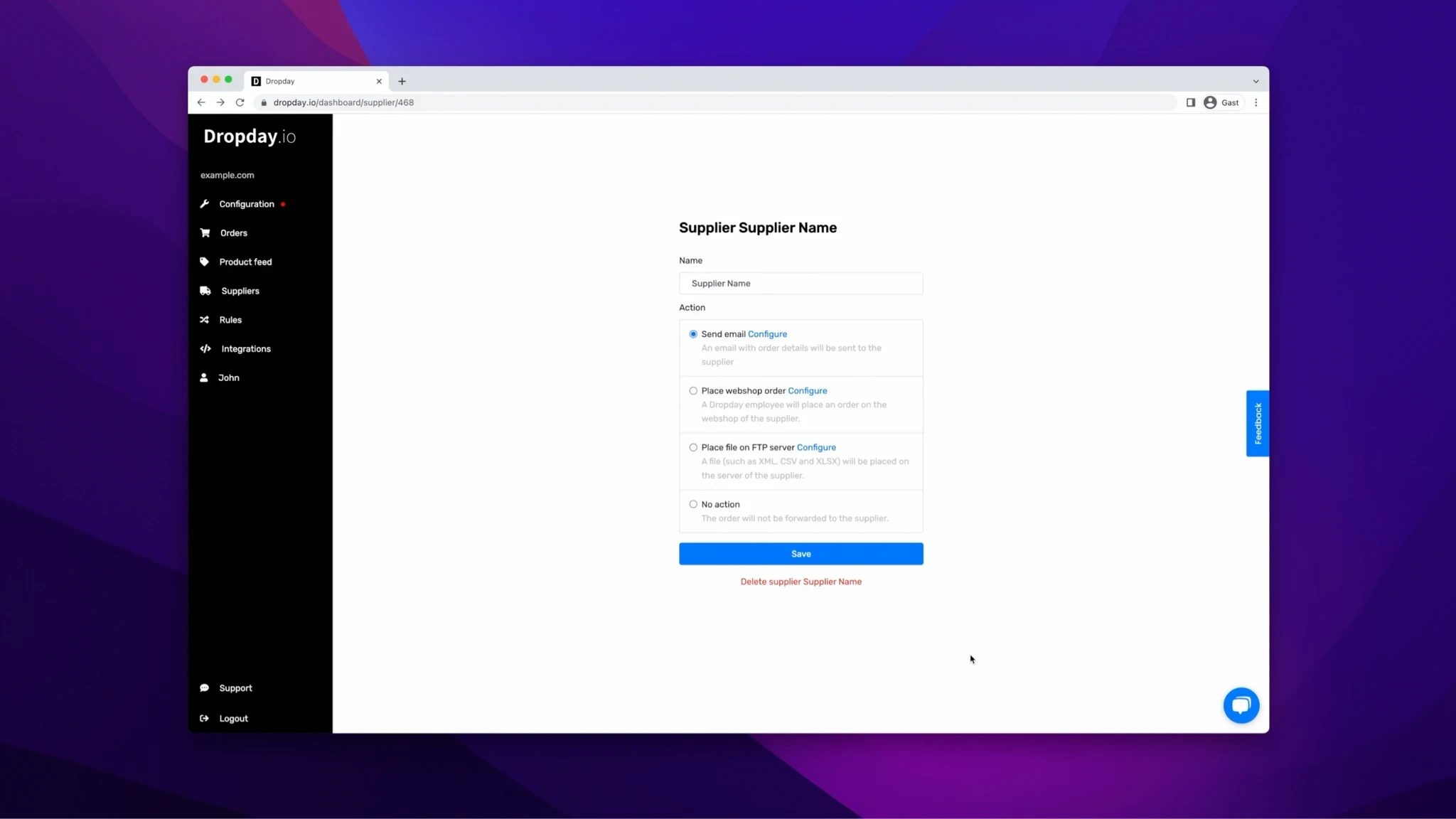
Building custom EDI mappings for every supplier directly within Magento is cost-prohibitive and difficult to maintain. Dropday acts as the middleware layer that connects your Magento store to any number of EDI-enabled suppliers.
Dropday ingests orders via the Magento API and applies your specific business rules. If an order contains products for an EDI-connected supplier, Dropday automatically generates the required file.
Custom Mapping Capabilities
Dropday supports custom EDI mappings. If a supplier requires a non-standard segment or a specific variation of an X12 document, the output can be configured to match those exact specifications. This flexibility allows webshops to say "yes" to suppliers with strict technical requirements without needing to hire EDI developers.
Automated Delivery
Once the file is generated, Dropday handles the delivery. Whether the supplier requires the file to be dropped into a specific FTP folder or sent via a secure connection, the transfer is automated. The system logs the transmission, providing transparency and proof of delivery for every order.
Process Control and Scalability
The goal of automating dropship edi workflows is process control. When orders are sent via magento edi protocols, the feedback loop is faster. If a file fails validation, the error is flagged immediately, allowing the operations team to intervene before the customer is affected.
This approach allows e-commerce businesses to scale order volume without adding administrative staff. By removing the manual composition of orders, you reduce the cost per order and increase the reliability of your supply chain.